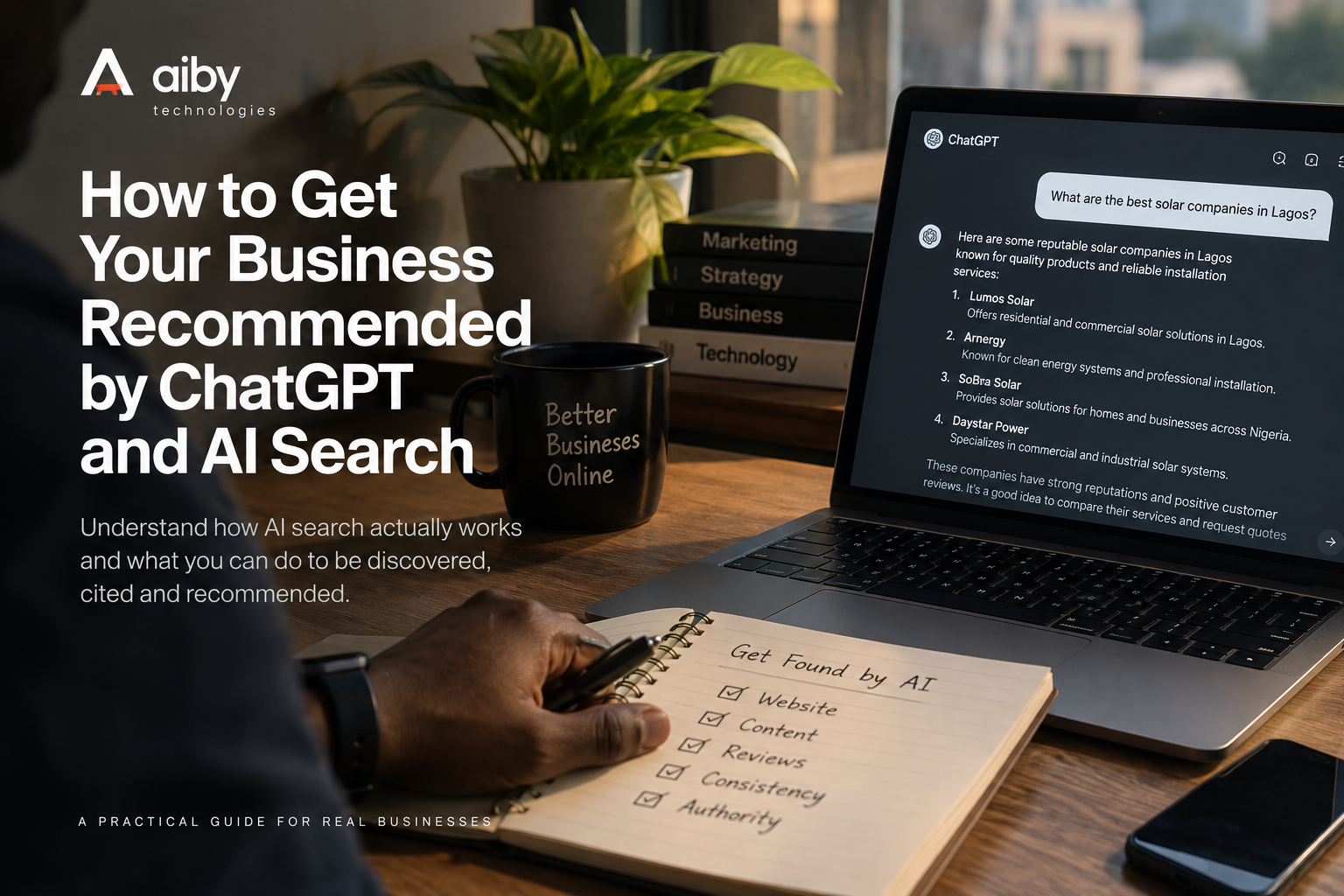
How to Get Your Business Recommended by ChatGPT and AI Search
You search Google for a business and Google gives you a list of websites.
Ask ChatGPT the same question and something different happens.
You might ask:
“Recommend a good solar company in Lagos.”
Instead of simply giving you ten links, an AI tool can research the question, compare information from different sources and come back with a few businesses it believes answer your question.
For businesses, that's a big change.
Because now the question isn't only:
“How do I rank on Google?”
It's also:
“How do I become one of the businesses AI finds and recommends?”
That's where Answer Engine Optimisation (AEO) comes in.
But before talking about how to optimise for AI, you need to understand what is actually happening when you ask an AI tool a question.
Once you understand that, AEO becomes much less mysterious.
First, where does AI get its information?
A useful way to think about it is that an AI assistant can have two broad sources of information.
The first is what the model learned during training.
The second is information it can retrieve when it searches the web or other connected sources.
That difference matters.
Imagine you started a company three months ago.
Your website is live. You've completed projects. Customers have reviewed you. You've been mentioned on a few websites.
But the AI model was trained before most of that happened.
It can't magically have all of that new information stored inside itself.
That's where web retrieval becomes important.
When an AI product has access to search and decides it needs current information, it can go looking for it.
And this is where things get interesting.
Because it may not search the way you do.
One question can turn into many searches
Let's say someone asks:
“What's the best solar company in Lagos for my house?”
You might imagine the AI searching exactly that sentence.
Not necessarily.
Modern AI search systems can use techniques such as query expansion and query fan-out.
In simple English: the original question can be broken into several related searches.
The system might explore things like:
- best solar companies Lagos
- residential solar installers Lagos
- solar installation companies Lagos reviews
- reliable solar companies Lagos
- home solar installation Lagos
- solar companies Lagos residential projects
Those aren't necessarily the exact searches a particular AI system will run. The point is that one question can create several paths for research.
And this changes SEO quite a bit.
For years, businesses have been taught to think:
“What keyword do I want to rank for?”
AI search forces you to think bigger:
“What questions would an AI need answered before it could confidently recommend my business?”
That's a much better way to approach AEO.
Then the AI has to make sense of what it finds
Now imagine those searches return dozens of sources.
Your website appears.
Your competitors appear.
Google Business Profiles appear.
An industry article mentions three companies.
Reddit users are discussing another one.
There are reviews.
There are directories.
There might be news articles, social profiles, case studies and other sources.
The AI now has a problem:
Which information should it use?
Different AI platforms have different systems for retrieving, ranking and selecting information, so there isn't one universal “AI ranking formula”.
But the basic problem is the same.
The system needs to work out what information is relevant and useful for answering the original question.
And this is where things like relevance, authority, freshness and corroboration start to matter.
That last one is particularly important.
You saying you're the best isn't the same as the internet saying it
Imagine your website says:
“We are the leading solar company in Lagos.”
Okay.
But you're the one saying it.
Now imagine something different.
Your website clearly explains your solar services.
Your Google Business Profile contains the same company information.
Customers have left genuine reviews discussing your installations.
An established publication has mentioned your company.
A solar industry website lists you.
You have detailed project pages showing actual installations.
Other credible websites refer to the same company, location and services.
Now there's a pattern.
Multiple independent sources are effectively telling the system:
This company exists.
This is what it does.
This is where it operates.
And other people know about it too.
That's much more useful than writing “#1 solar company” twenty times on your homepage.
This is one of the biggest ideas behind AEO:
Don't just make claims. Build evidence around your business.
Then comes the part most people misunderstand: the answer
AI recommendations aren't necessarily a fixed leaderboard.
There isn't always a permanent database somewhere saying:
- Company A
- Company B
- Company C
Generative AI produces answers probabilistically.
Ask the same question in a different way and the answer can change.
Ask again next month and new information may be available.
A different AI platform may retrieve different sources.
Even context within the conversation can affect what the user receives.
So trying to become permanently “#1 on ChatGPT” is the wrong mental model.
The better goal is:
When AI researches questions related to my industry, how do I increase the chances that my business keeps appearing in the information it finds?
And then:
How do I give it enough evidence to feel confident using or citing that information?
That's AEO.
So, how do you actually optimise your business for AI search?
Now that we understand the process, the strategy starts to make sense.
Make it painfully obvious what your business does
Go to your homepage and read the first few sections.
If you've never heard of the company before, can you immediately answer:
What does this company do?
Where does it operate?
Who does it serve?
You'd be surprised how many websites fail this test.
They say things like:
“Building innovative solutions for tomorrow.”
Great.
But what do you actually sell?
If you're a solar company in Port Harcourt, say you're a solar company serving Port Harcourt and explain the services you provide.
If you design websites for Nigerian businesses, make that clear.
Don't make people—or machines—decode your marketing language.
Stop building your website around one keyword
This is where understanding query fan-out becomes useful.
Suppose you're a real estate company.
You don't want one page desperately trying to rank for:
“best real estate company Lagos.”
Think about everything surrounding the decision.
People might ask:
Where should I buy property in Lagos?
Is Lekki property a good investment?
How much does land cost in Ibeju-Lekki?
Which real estate companies sell verified land?
How do I verify land documents in Lagos?
What documents should I check before buying property?
Which estates are available in Lekki?
Now your website can become genuinely useful across the entire topic.
That's topical authority.
And if an AI system fans a user's question out into several related searches, you've given yourself many more opportunities to appear.
Give AI something worth citing
This might be one of the most overlooked parts of AEO.
Most business blogs are full of articles that say exactly what another 500 websites already say.
That doesn't make them particularly useful sources.
Instead, publish things that originate from your business.
A construction company could publish actual construction cost data from completed projects.
A solar company could publish:
“What 50 Solar Installations Taught Us About Power Consumption in Lagos Homes.”
A property company could analyse its own sales data.
A marketing agency could publish results from campaigns it has actually run.
You can publish:
**Original data.
Experiments.
Case studies.
Industry surveys.
Research.
Real project results.
Expert observations.**
Give the web information that didn't exist before you published it.
Now you aren't merely trying to rank.
You're becoming a source.
Your reputation outside your website matters too
You control your website.
That's exactly why an external source can sometimes be valuable corroboration.
If your website says you're an excellent company, that's marketing.
If customers independently say it, that's another signal.
If recognised industry websites mention you, that's another.
If reputable publications reference your research, that's another.
If legitimate business databases contain consistent information about your company, that's another.
The goal isn't to go and create 200 spammy directory profiles.
It's to build a real digital footprint.
When different credible sources independently point toward the same facts, AI systems have more evidence to work with.
Keep your information consistent
Imagine trying to research a company and finding:
One website says it is based in Lagos.
Another says Abuja.
Its LinkedIn page describes completely different services.
Its Google Business Profile uses a different business name.
An old directory contains a website it stopped using three years ago.
Which information should you trust?
AI systems encounter the same problem.
Keep important information about your business reasonably consistent across the web:
Your name.
Your website.
Your services.
Your location.
Your leadership.
Your contact information.
Your official profiles.
Make it easy to understand that all these pieces of information belong to the same business.
Don't forget traditional Google SEO
AEO isn't replacing SEO.
They overlap.
If an AI system searches the web to answer a question, your content still has to be discoverable.
Your website still needs sensible architecture.
Google still needs to crawl and index your pages.
Internal links still matter.
Good content still matters.
Authority still matters.
Technical SEO still matters.
If your business isn't appearing in traditional search at all, start with our guide on [Why Is My Business Not Showing Up on Google? 9 Reasons.
](/blog/why-is-my-business-not-showing-up-on-google-9-reasons)
And if local customers are important to your business, our Local SEO services focus specifically on improving how businesses are discovered through local Google searches.
Can you guarantee that ChatGPT will recommend your business?
No.
And you should be suspicious of anyone promising that they can guarantee it.
AI answers change.
Models change.
Search indexes change.
Sources change.
The way someone phrases a question changes.
AEO isn't about finding a secret button that permanently puts your company inside ChatGPT.
It's about increasing the probability that when AI systems go looking for businesses, people, products or information in your space, your business is one of the entities they can clearly discover, understand and verify.
That's a much more realistic way to think about it.
The businesses that understand this early have an opportunity
Google changed how businesses thought about the internet.
Businesses learned that having a website wasn't enough. They needed to make that website discoverable.
We're entering another version of that transition.
People aren't going to stop using Google tomorrow.
But they're increasingly comfortable asking AI to do some of the searching, researching and comparing for them.
That means your future customer might not discover you by typing your keyword into Google and scrolling through ten websites.
They might simply ask:
“Who should I hire?”
And the AI will do some of that research for them.
Your job is to make sure that when it does, there is enough clear, credible and useful information about your business for you to be part of the answer.
That's what Answer Engine Optimisation is really about.
Aiby Technologies helps businesses build that visibility through Answer Engine Optimisation (AEO)—strengthening the websites, content, entity signals and wider digital presence that AI-powered search systems can use to understand a business.