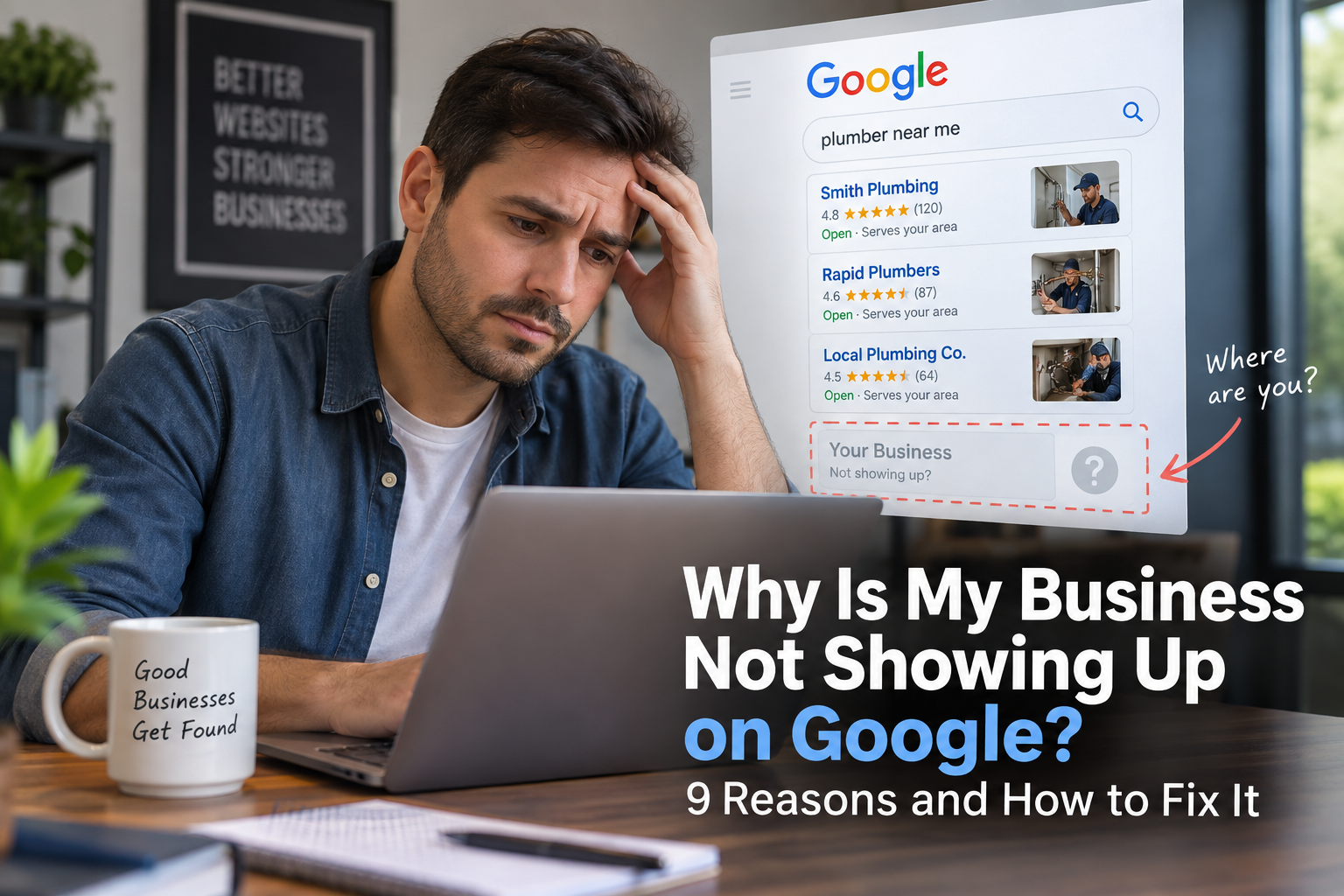
Why Is My Business Not Showing Up on Google? 9 Reasons and How to Fix It
You have a real business. You have customers. You may even have a website and a Google Business Profile.
But when you search for the services you offer, your competitors appear on Google — and your business is nowhere to be found.
This is a common problem, especially for local businesses.
The important thing to understand is that simply having a website or creating a Google Business Profile does not automatically mean your business will rank highly when potential customers search for your services.
In this guide, we'll explain why your business may not be showing up on Google and what you can do to improve your visibility.
1. Google Doesn't Clearly Understand What Your Business Does
Google needs enough information to understand your business before it can confidently show it for relevant searches.
Imagine you run a solar installation company.
Someone searches:
“solar installation company near me”
For Google to consider your business, it needs signals that clearly connect your company with solar installation.
Those signals can come from your:
* Google Business Profile
* Website
* Service pages
* Business categories
* Business description
* Reviews
* Other websites mentioning your company
Google describes one of the main factors behind local rankings as relevance — essentially, how closely a business matches what someone is searching for.
Your website and Google Business Profile should therefore make your services extremely clear.
Don't make Google guess what your company does.
2. Your Google Business Profile Isn't Properly Optimised
Creating a Google Business Profile is only the beginning.
Your profile should contain accurate and detailed information about your business, including your primary business category, additional relevant categories, services, opening hours, website, phone number, service area or address where appropriate, photos and other applicable business information.
Google says complete and accurate information can make businesses more likely to appear in relevant local search results.
Think of your Google Business Profile as your business's storefront on Google Search and Google Maps.
The more accurately it represents your real business, the easier it becomes for Google and potential customers to understand what you offer.
3. Your Website Isn't Optimised for the Services You Want to Rank For
One mistake businesses make is relying entirely on their Google Business Profile.
Your website matters too.
Google can use publicly available information from a business's official website as one of the sources of information about that business.
Your website should clearly explain:
What you do.
Where you operate.
Who you serve.
For example, instead of having one generic page saying:
“We provide quality solutions for our customers.”
a solar company might have dedicated pages explaining services such as:
Residential Solar Installation
Commercial Solar Installation
Solar Inverter Installation
Solar Battery Installation
This gives search engines considerably more context about the business.
4. You're Trying to Rank for Everything From One Page
Your homepage shouldn't have to do all the work.
Suppose an accounting company offers:
* Tax preparation
* Bookkeeping
* Payroll services
* Business accounting
* Financial consulting
Trying to rank one homepage for every one of those searches can make it difficult to build strong relevance around each individual service.
A better website structure would include useful, dedicated pages for the company's important services.
For example:
/bookkeeping/
/payroll-services/
/tax-preparation/
Each page can thoroughly answer the questions potential customers have about that particular service.
This isn't about creating hundreds of thin pages simply to target keywords.
Each page should genuinely help someone understand the service and decide whether the business is suitable for them.
5. Google Doesn't Have Enough Evidence That Your Business Is Prominent
Another major local ranking factor is prominence.
In simple terms: how established and well-known does your business appear to be?
Google says prominence can be influenced by information about a business from across the web, including links and other signals. Review count and review scores can also contribute to local ranking.
This is why building your online presence beyond your own website matters.
A business that is consistently represented across its website, Google profile, reputable directories, industry websites and other relevant sources gives search engines more information with which to understand it.
6. You Don't Have Enough Reviews — or You're Ignoring Them
Reviews aren't only useful for convincing potential customers.
They can also contribute to local search visibility.
Google specifically states that more reviews and positive ratings can help local ranking.
That doesn't mean businesses should buy reviews or manipulate them.
Instead, build a legitimate process for asking genuine customers to leave feedback after you've provided a service.
And don't simply collect reviews.
Respond to them.
A thoughtful response shows future customers that someone is actively managing the business and paying attention to customer experiences.
7. Your Business Information Is Inconsistent Online
Imagine your website says:
ABC Solar Limited
but one directory says:
ABC Solar
and another has an old phone number or outdated location.
Occasional variations don't automatically destroy your rankings, but inaccurate information across important sources can create unnecessary confusion for customers and search systems.
Keep your core business information accurate wherever your company has an important presence online.
That includes your business name, contact information, website and physical location where applicable.
8. You're Ignoring Location
Google local search is different from ordinary website search.
Location matters.
Google identifies distance as one of the primary factors used for local results.
Someone searching for a plumber from one side of a city can therefore see different local results from someone performing the same search somewhere else.
This means there is no legitimate SEO strategy that can guarantee your business will always be number one on Google Maps for everyone.
The goal should be to improve your relevance and prominence so that Google has stronger reasons to consider your business when it is geographically appropriate.
9. Your Competitors Have Built More Search Authority
Sometimes nothing is technically “wrong” with your business.
Your competitors have simply invested more into their Google presence.
They may have:
* Better service pages
* More useful website content
* More genuine customer reviews
* Stronger links from other websites
* Better local relevance
* A more established online presence
This is where SEO becomes a long-term business asset.
You aren't only trying to “put keywords on a website.”
You're building enough evidence across the web for search engines to understand:
This business exists.
This is what it does.
This is where it operates.
Other people and websites recognise it.
Customers trust it.
What Should You Do If Your Business Isn't Showing Up on Google?
Start with the fundamentals.
Search for the services you actually want customers to find you for.
Look at which businesses currently appear.
Then compare their Google presence with yours.
Check your Google Business Profile, website structure, service pages, reviews, business information and overall search presence.
You should also make sure your website can actually be crawled and indexed by Google.
SEO isn't about finding one secret setting that suddenly puts your business at the top.
It is about making your business easier for search engines to understand, verify and match with relevant searches.
What About Getting Your Business Found Through AI?
Business discovery is also expanding beyond traditional Google results.
People increasingly ask search and AI platforms questions such as:
“What are the best solar companies near me?”
“Recommend a web design company for a small business.”
“Find a reliable construction company in my city.”
That makes having a clear, authoritative online presence even more important.
The same foundation matters: a well-structured website, clear information about your company and services, consistent business information, useful original content and evidence from other sources across the web.
There is no legitimate method that can guarantee that ChatGPT or another AI platform will recommend a particular business.
The objective of AI search optimisation, sometimes called AEO (Answer Engine Optimisation), is to make your business and its information easier for relevant systems to discover, understand and potentially use when answering questions.
Want to Improve Your Business's Visibility on Google?
Aiby Technologies helps businesses build stronger online visibility through website design, Local SEO, Google Business Profile optimisation and AI search/AEO strategies.
If customers are searching for the services you provide but finding your competitors instead, the first step is understanding what's preventing your business from appearing.
A proper visibility audit can identify those gaps and show where your website and Google presence need improvement.